A human-in-the-loop agent with LangGraph interrupt()
· 10 min read
In the overview of my digital twin I wrote one paragraph about human approval: when the model reaches for the tool that speaks for me, the graph pauses and nothing happens until I say so. That paragraph hides the most interesting engineering in the project. This post is the mechanism, with the actual code on both sides of the pause.
Why some tools must not run autonomously
The agent has three tools. Two of them are read-only: search_knowledge
and get_availability. The third, draft_contact_message, records a
message from a visitor to me. That is the one that can embarrass me, spam
me, or commit me to something, so it is the one that carries a flag on the
tool definition itself:
@dataclass(frozen=True)
class Tool:
    name: str
    description: str
    parameters: dict[str, Any]
    run: Callable[..., Any]  # deterministic, side-effect free
    timeout_s: float = 5.0
    # High-risk tools never run without an explicit human approval.
    high_risk: bool = False
Tool(
name="draft_contact_message",
description=(
"Submit a message from the visitor to Ruud (hiring inquiry, "
"collaboration, question). ..."
"Requires Ruud's personal approval before it is "
"recorded — tell the visitor it was submitted for approval."
),
...
high_risk=True,
),The point of putting high_risk on the Tool dataclass rather than in a
prompt is that the model has no say in it. The prompt tells the model to
mention the approval; the graph enforces it.
interrupt() instead of a pending flag
The obvious way to build this is a pending flag: the tool call goes into a
table, the run ends, and a second code path later reads the row, executes
the tool and calls the model again with a reconstructed history. I have
built that before. The problem is the reconstruction: everything the
model had in context at the moment it asked for the tool — the
conversation, the earlier tool results, the running cost — has to be
serialised by hand and replayed correctly, and every field I forget is a
subtle bug on resume.
LangGraph's interrupt() does the serialisation for me. The graph is
compiled with a checkpointer, so every node boundary is persisted per
thread_id. Calling interrupt(payload) inside a node stops the run and
writes the full state to the checkpoint. Resuming the same thread_id with
Command(resume=value) makes interrupt() return value inside the node,
and the run continues as if nothing had happened. The pending flag becomes
a property of the checkpoint (snapshot.interrupts) instead of a column I
maintain.
Which checkpointer is behind that matters for durability, and the code is explicit about it:
@asynccontextmanager
async def _checkpointer(settings: Settings) -> AsyncIterator[BaseCheckpointSaver]:
    """Postgres checkpoints when DATABASE_URL is set; otherwise threads live
    only as long as the process (tests, quick bare-metal dev)."""
    if settings.database_url:
        async with AsyncPostgresSaver.from_conn_string(settings.database_url) as saver:
            await saver.setup()  # manages its own tables, outside alembic
            yield saver
    else:
        yield InMemorySaver()
With DATABASE_URL set, the paused thread sits in Postgres and survives a
restart or a redeploy; I can approve it a day later. Without it, the graph
runs on InMemorySaver, and a restart drops every paused thread. The tests
run in that second mode.
Pausing: the graph and the visitor's stream
The generate node streams the model's turn and, if the model asked for
tools, puts them in pending_tools. The conditional edge after it decides
what happens next:
def _high_risk(call: dict[str, Any]) -> bool:
    tool = tools_by_name.get(call["name"])
    return tool is not None and tool.high_risk

def route_after_generate(state: AgentState) -> str:
    pending = state.get("pending_tools") or []
    if not pending:
        return "verify"
    decided = (state.get("approval") or {}).get("decided")
    if any(_high_risk(call) for call in pending) and not decided:
        return "request_approval"
    return "execute_tools"
The decided check is what keeps the resumed run from interrupting a
second time: after the decision lands in state["approval"], the same edge
routes straight to execute_tools. And guard_input resets approval to
None at the start of every run, so a decision never leaks into the
visitor's next question.
The node itself is small. The payload passed to interrupt() is what I
will later see in the admin queue; the return value is my decision:
async def request_approval(state: AgentState) -> AgentState:
    # interrupt() pauses the graph and checkpoints it; the visitor's
    # stream ends with a pending notice. When Ruud decides via the admin
    # endpoint, the graph resumes here and interrupt() returns his decision.
    decision = interrupt(
        {
            "tool_calls": [
                {"name": call["name"], "input": call["input"]}
                for call in state.get("pending_tools") or []
                if _high_risk(call)
            ],
            "visitor_message": state["turns"][-1]["content"],
        }
    ) or {}
    approved = bool(decision.get("approved"))
    logger.info("High-risk action %s by Ruud", "approved" if approved else "rejected")
    return {"approval": {"decided": True, "approved": approved, "note": decision.get("note")}}
The edges are plain: request_approval → execute_tools → generate, so once
the decision is in, the tool result goes back to the model and the model
finishes its answer.
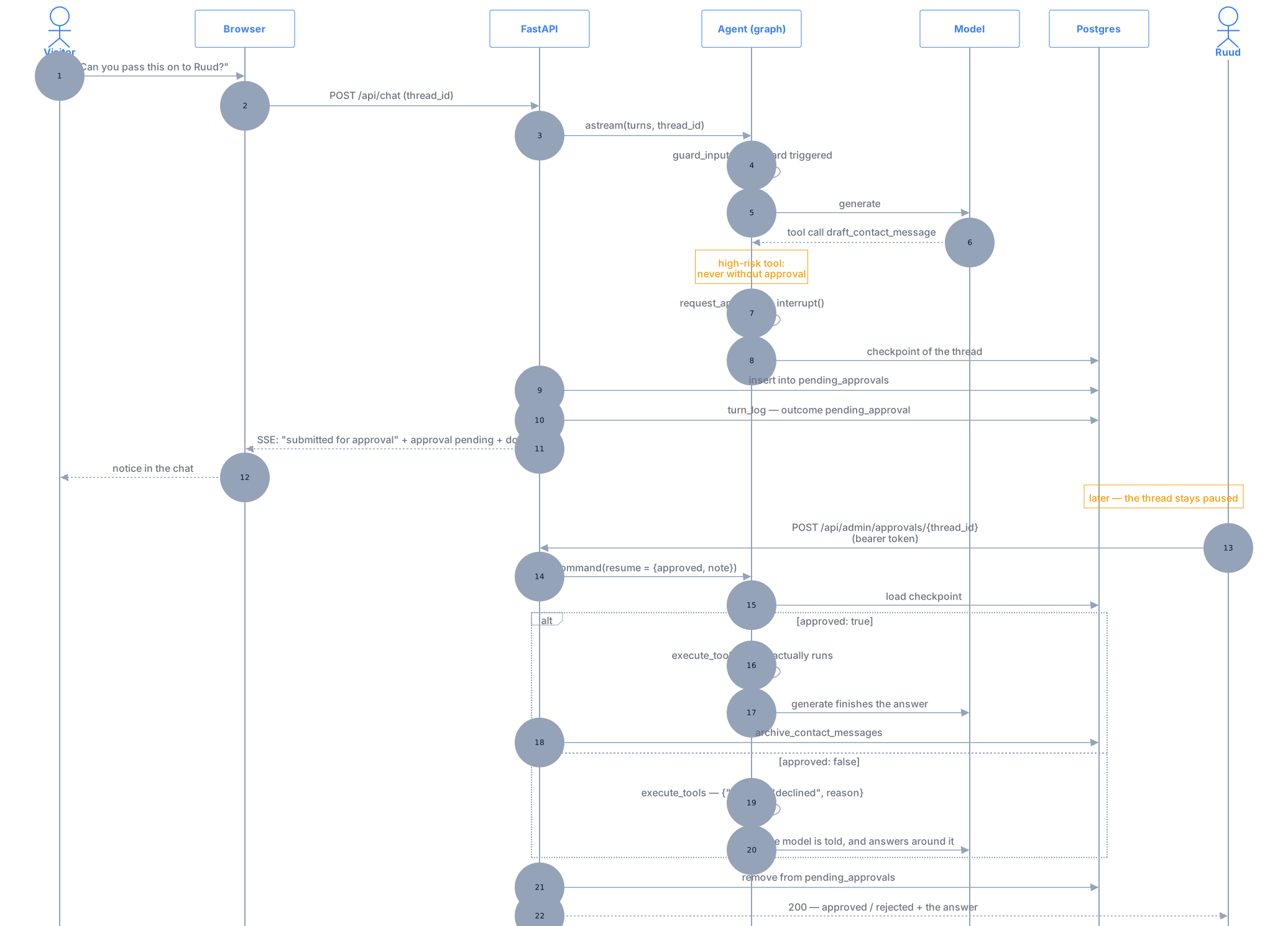
On the visitor's side, astream simply returns when the graph interrupts.
The chat endpoint then inspects the thread's state to find out whether the
run ended because the answer was done or because it was paused:
async for event in agent.astream({"turns": turns}, config, stream_mode="custom"):
    ...
    yield sse(event)
snapshot = await agent.aget_state(config)
...
if snapshot.interrupts:
    # A high-risk tool paused the graph for Ruud's approval. Queue it
    # for the admin endpoint (durable with a database) and tell the visitor.
    outcome = "pending_approval"
    await app_state.approvals.add(thread_id, snapshot.interrupts[0].value or {})
    yield sse({"type": "text", "text": APPROVAL_NOTICE})
    yield sse({"type": "approval", "status": "pending"})
APPROVAL_NOTICE = (
"\n\nThis request needs Ruud's personal approval — it has been queued for his review."
)Two things happen here. The interrupt payload is copied into an approval
queue (PostgresApprovalStore with a database, InMemoryApprovalStore
without), which exists so the admin side can list what is waiting; the
checkpoint remains the source of truth. And the visitor's stream ends with
three events: a text event carrying the notice, an
approval event with status: "pending", and the usual done. The
browser client only renders text events, so what the visitor actually sees
is the notice appended to whatever the model had already said. With a
database configured, the turn is logged with outcome pending_approval.
Resuming: the admin endpoint and fail-closed execution
The admin router is protected by a bearer token; with no ADMIN_TOKEN
configured the endpoints are simply off (403). The resume endpoint is one
function:
@router.post("/approvals/{thread_id}")
async def decide_approval(
    request: Request, decision: ApprovalDecision, thread_id: str = THREAD_ID
) -> Any:
    if (denied := _unauthorized(request)) is not None:
        return denied

    agent = request.app.state.agent
    config = {"configurable": {"thread_id": thread_id}}
    snapshot = await agent.aget_state(config)
    if not snapshot.interrupts:
        return JSONResponse(
            status_code=404, content={"error": "No pending approval for this thread."}
        )

    pending = await request.app.state.approvals.get(thread_id)

    # Resume from the checkpoint; interrupt() in the graph returns this value.
    resume = Command(resume={"approved": decision.approved, "note": decision.note})
    answer: list[str] = []
    async for event in agent.astream(resume, config, stream_mode="custom"):
        if event.get("type") == "text":
            answer.append(event["text"])
    ...
    await request.app.state.approvals.remove(thread_id)
    status = "approved" if decision.approved else "rejected"
    logger.info("Approval %s for thread %s", status, thread_id)
    return {"status": status, "thread_id": thread_id, "answer": "".join(answer)}
Note what the 404 is keyed on: snapshot.interrupts, the checkpoint, not
the queue. A thread that isn't actually paused cannot be "approved" into
running something. The Command(resume=...) value is exactly the dict that
interrupt() returns inside request_approval. The same astream call
then runs execute_tools and the final generate, and the model's closing
text comes back in the admin response as answer and lands in the thread
state. Nothing pushes it to the visitor's browser: that SSE connection
closed when the notice went out.
The fail-closed part lives in execute_tools, and it is deliberately not
"if rejected, skip":
if tool.high_risk and not approval.get("approved"):
    # Fail closed: without an explicit approval the action never runs.
    detail = {
        "status": "declined",
        "reason": approval.get("note") or "Ruud declined this request.",
    }
    results.append(_tool_message(call, json.dumps(detail)))
    continue
if tool.high_risk:
    drafts.append({"tool": name, "input": call["input"]})
The condition is not approval.get("approved"). An empty approval, a
missing key, a None, a resume payload without the field: all of them
decline. Only an explicit approved: True reaches the run. The declined
result goes back to the model as a normal tool message, so the model can
tell the visitor honestly that the request was not passed on, with my note
as the reason if I gave one. Approved drafts are additionally appended to
contact_drafts, which is checkpointed for the thread's lifetime, and the
admin endpoint archives them into the contact_messages table when a
database is present.

What the tests pin down
server/tests/test_approvals.py drives the whole path through FastAPI's
TestClient with a fake chat-completions backend that answers the first
request with a draft_contact_message tool call and the second with plain
text. The helper that starts a paused thread asserts the shape of the pause:
events = parse_events(response.text)
assert {"type": "approval", "status": "pending"} in events
assert any(e.get("text") == APPROVAL_NOTICE for e in events)
assert recorder.calls == 1  # paused before any execution or second model call
That last line is the one I care about most: exactly one model call happened before the pause. Then five tests cover the two sides:
test_high_risk_tool_pauses_and_lists_pending—GET /api/admin/approvalslists the thread with the tool call input and the visitor's message.test_approving_resumes_executes_and_records_draft— afterPOST /api/admin/approvals/t-approvewith{"approved": true}, the queue is empty, the second model request carries a tool message containing"recorded", the responseansweris the model's final text, andcontact_draftsin the thread state holds the draft.recorder.calls == 2.test_rejecting_declines_without_executing— with{"approved": false, "note": "Not taking projects right now."}, the tool message contains"declined"and my note verbatim.test_admin_endpoints_require_token— no token and a wrong token both get 401; a valid token on a thread with nothing pending gets 404.test_admin_endpoints_disabled_without_token— withADMIN_TOKENempty, the endpoints return 403.
What is not tested: durability across a process restart. The tests run
without DATABASE_URL, so they exercise InMemorySaver and
InMemoryApprovalStore. The Postgres path is the same code with a different
saver, but I have no automated proof that a paused thread survives a
restart; that is something I verify by hand on the deployed instance.
Takeaways
- Put the risk flag on the tool object, not in the prompt.
high_risk=Trueis read by the router and the executor; the model only gets told to mention it. interrupt()turns "pending" into a property of the checkpoint. There is no history to reconstruct on resume, and the admin endpoint refuses to resume anything thatsnapshot.interruptsdoesn't say is paused.- Fail closed by testing for the positive:
not approval.get("approved")declines every state except an explicitTrue. - Return the decline to the model as a tool result. It can then say what actually happened instead of pretending the message went out.
- Be honest about what the checkpointer is. In-memory means every paused thread dies with the process; the tests run that way, production doesn't.
Like how I think about this?
I'm open to new roles in data engineering and AI. Let's talk.
Get in touch